Adoption With Humanity


My husband and I chose to adopt and now we have two wonderful children, Gaia and Luca. But before that there was a road that often seemed to lead to nowhere, laden with bureaucracy and endless obstacles. I began to wonder if this was actually an attempt by the UK government to make adoption difficult. When our local council told us we were ‘too white’ to adopt one of the thousands of black or mixed race children available we knew something was rotten in the system.

Many people give up at that point. In fact many people give up long before this. My husband and I were lucky. We had the financial resources, the know how from working in big businesses and most of all, a united belief that we were not going to let them beat us.

Not everyone has our advantages or tenacity. They shouldn’t need it. What matters is that there are children languishing in care and people who want to give them a permanent stable home, but it’s not working. Adoption with Humanity is about campaigning for a more humane adoption process, one that puts people at its heart.

Our Proposed Solution to the Adoption Crisis

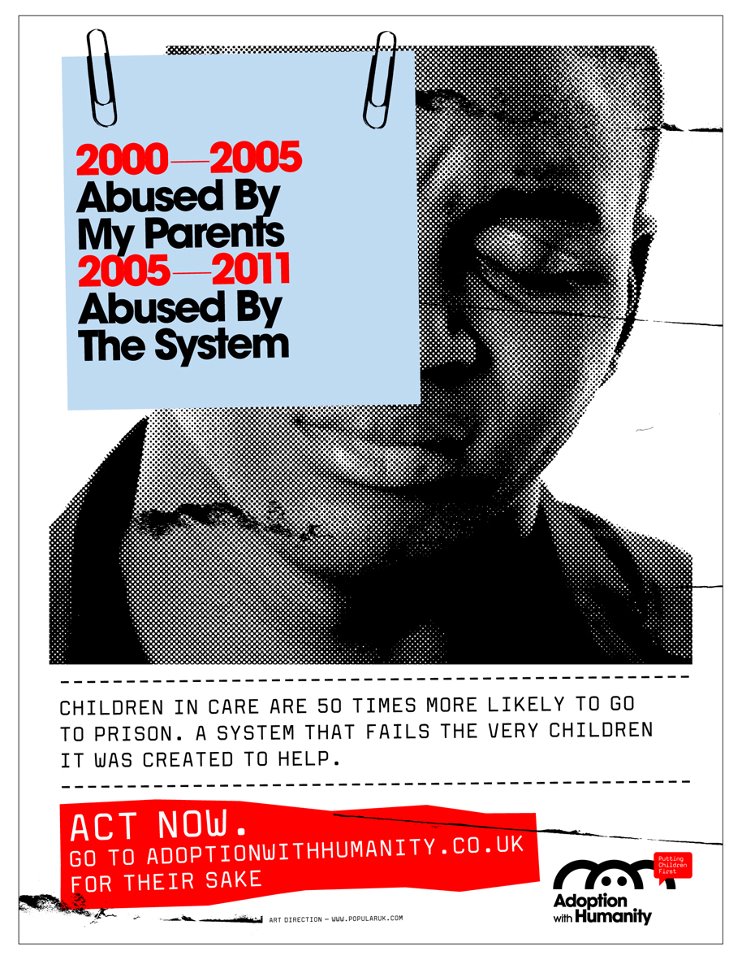
There can be no doubt that the current adoption system is failing the very children it is was created to help.

There are significant problems of delays, of the very structure of the system and of the attitudes and training of those who work within it.

We believe that the core of the solution is the development and implementation of a completely new ethos behind adoption: one in which the best interests of the child are genuinely given priority and where adoption is seen as a positive way of ensuring that a child is cared for in a family situation; and where those who put themselves forward for this role are accepted and welcomed as a constructive resource.

An examination of the issues as outlined below seems to lead to one central conclusion: there is an authority vacuum.

a.   Problem of Delays

1.  The time it takes to bring children into the care system (when they are obviously being neglected)

2.   The length of time it takes a child to be adopted – due to system being too bureaucratic

3.    Social workers’ attitudes in seeking the perfect match (when “suitable” is sufficient)

4.    Appalling delays in courts and with Guardians

b.    Problem of attitudes and lack of appropriate training

1.    Professional role – personal opinions vs policies local and national

2.    The key role of social work and the courts being seen as the preservation of the biological family

3.    Individual antipathy to adoption

4.    Desire (at almost all costs) to keep children with birth families

5.    Obstruction to “less than perfect” adoption

6.    Issue of misuse of Special Guardianship as quicker and cheaper option when in fact often its use is not compatible with the best interests of the child

7.    Putting off / turning away too many potential adopters

c.   The way the adoption system is set up

1.    Lack of rational control structure across all the elements of adoption

2.    Problem of government not having control over local authorities or courts hence problem of ensuring any change in policy/guidelines is adhered to (see recent changes in ethnic guidelines…)

3.    Budget structure within local authorities plus anomalies like courts being able to spend local authority budgets on additional reports etc with no local authority control

4.    Cross charge of real cost of home studies and no more has led to a disincentive to prepare more adopters than are strictly needed by an authority leading to a national shortage of prepared adopters (plus additional delays for a child if prepared adopters are not available when adoption becomes the plan for him/her.)

5.    No proper integration with the court system and their interpretations of human rights

6.    Local authorities working independently / lack of co-ordination – may turn down a potential adopter in one authority because no suitable match when the next door authority may have a suitable child available for adoption.

7.    Broad spectrum of standards & policies and achievements of local authorities – effects of leadership/management or lack thereof

From these points we are inevitably drawn to the conclusion that there is an authority vacuum and thus an imperative need for the government to put in place a major intervention which will create a rational control structure to move adoption practice forward in the UK and ensure that its policies can be realized (and measure that success).This would be achieved by setting up a National Adoption Authority (NAA). This body will have the authority and power to devise new policies and practices that would be enforceable by the National Adoption Authority over local authorities and courts.

Although this might seem revolutionary it’s actually purely evolutionary. It allows the government to take the initiative and create the mechanism to address the issues whilst avoiding the compartmentalisation based on old policies and the biases that are so ingrained in our current system.

We would suggest that the NAA would be governed by a mixed representative body covering the whole spectrum of adoption including social workers and legal representatives but also experts such as psychologists, doctors, birth mothers, adoptive parents and adoptees who would offer a thorough view on adoption as seen from all aspects.

Its operational team would enforce policies and guidelines set by the government and based on best practice and empirical evidence. It would have authority over all adoption agencies, and have a strong role with regard to adoption courts and the integration of procedures between them, including early and continuous co-ordinated planning.

A key feature which we believe should attend the creation of the National Adoption Authority is the idea of the budget being allocated to the child (similar to a statement of educational needs) and the creation of a separate national budget for the assessment and preparation of potential adopters with the Authority being responsible for the analysis of the correctness of its value and the efficacy of its use.

Another core function would be to take over the “inspection” role which has to date been undertaken by OFSTED. Crucially it would be in a position to gather, analyse and publish statistics and genuinely audit data on the whole of the adoption system.

We believe the National Adoption Authority should also have a significant role in defining the training curriculum and oversee its implementation. Organisations such as the Adoption Register and the Independent Review Mechanism would also fall within its remit. Finally we believe it should continue the really vital work of the Adoption Research Initiative in providing the evidence on which to base policies in the future.

Financially we would see the budget coming from the reallocation of the budget for the current policy team at the Department of Education, the other organisations mentioned and the relevant budgets granted to local authorities. The significant improvements to the system that would result from enforcing standards and policies, shortening time in care, and reducing waste by proper co-ordination between agencies and the courts should be sufficient to create significant improvements without the need for additional budgets.

We are aware the government does not want to create major centralized bodies or QUANGOs but is a keen supporter of local solutions. The creation of a National Adoption Authority follows a tried and tested route, particularly familiar to the Dept of Education who currently have responsibility for adoption in the UK, of having a central policy setting authority and delegated local implementation.

The creation of such an authority would avoid some of the dangers present in other options. For example we are concerned that were one to follow the route of creating a National Adoption Authority, there would be a significant danger of replicating the same attitudes and behaviours – because almost inevitably it would in large part be formed by the same individuals and maintain the current ethos. It is also a more radical solution which would create greater disruption, cost more and take more time – a National Adoption Authority would be a more evolutionary, more easily achievable step and one which we believe should be given serious consideration as the optimum structure to reform adoption in the UK.

We welcome your views. Please join in the discussion below.

Help fix our broken adoption system by clicking this link.

SignOurPetition2 Adoption With Humanity

Share and Enjoy

  • wp socializer sprite mask 16px Adoption With Humanity
  • wp socializer sprite mask 16px Adoption With Humanity
  • wp socializer sprite mask 16px Adoption With Humanity
  • wp socializer sprite mask 16px Adoption With Humanity
  • wp socializer sprite mask 16px Adoption With Humanity
  • wp socializer sprite mask 16px Adoption With Humanity
  • wp socializer sprite mask 16px Adoption With Humanity
  • wp socializer sprite mask 16px Adoption With Humanity